Go Language - Maps - Example
A map is an unordered collection of key/value pairs, where each key is unique. We can create a new map with a make statement or a map literal. The default zero value of a map is nil. The len function returns the size of a map. Go Range keyword is used in different kinds of data structures in order to iterate over elements.
Create a Map:
Create a Map called users that will store int keys and String values:
/* Create a new map * Empty map of string-string pairs */ users := make(map[int]string)
Add Items:
Add a new key-value pair,
//Add Items users[1] = "scott" users[2] = "june" users[3] = "april" users[4] = "carl" users[5] = "rick" users[6] = "daryl"
Update Value:
// Update value users[6] = "michonne"
Iterate over all keys and values:
// Iterating over all keys and values for id, name := range users { fmt.Printf("id :%d name: %s\n", id, name) }
Access an Item:
//Access an Item fmt.Println("\n", users[1], "\n")
Remove an Item:
//Remove an Item delete(users, 3)
Test if entry is present in the map or not:
// Test if entry is present in the map or not _, status := users[4] fmt.Println("\n", status, "\n")
Complete Code:
package main
import "fmt"
//Required imports
func main() {
    /* Create a new map     * Empty map of string-string pairs     */    users := make(map[int]string)
    //Add Items    users[1] = "scott"    users[2] = "june"    users[3] = "april"    users[4] = "carl"    users[5] = "rick"    users[6] = "daryl"
    fmt.Println("\n")
    // Iterating over all keys and values    for id, name := range users {        fmt.Printf("id :%d name: %s\n", id, name)    }
    // Update value    users[6] = "michonne"
    fmt.Println("\n")
    // Iterating over all keys and values    for id, name := range users {        fmt.Printf("id :%d name: %s\n", id, name)    }
    //Access an Item    fmt.Println("\n", users[1], "\n")
    //Remove an Item    delete(users, 3)
    // Iterating over all keys and values    for id, name := range users {        fmt.Printf("id :%d name: %s\n", id, name)    }
    // Test if entry is present in the map or not    _, status := users[4]    fmt.Println("\n", status, "\n")}
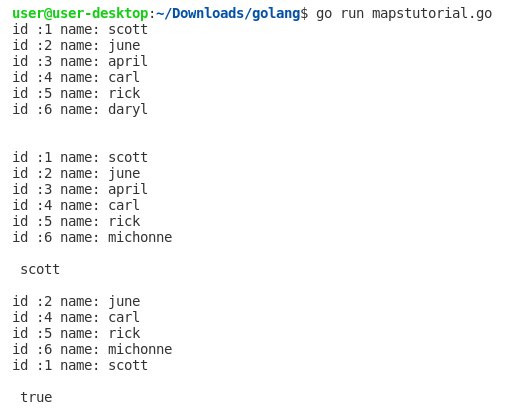
Output:


Comments
Post a Comment